Chapter 1: SEO Basics: How Google Search Actually Works

- 16 min read
- 0
Many people begin learning SEO with keywords. Today they research one keyword, tomorrow they write a blog post, the day after they build a few backlinks, and then they check their rankings in Search Console. After doing this for a long time, they discover that SEO seems to have an endless list of things to do. But if you take these actions apart, they are not isolated tricks. Writing articles, doing keyword research, building site structure, internal linking, external linking, building product pages, and technical SEO are all essentially solving the same problem: how to help search engines understand who you are, what you do, what value you offer, and why your pages should be shown to the people who actually need them. So the first step in understanding SEO is not to study a single keyword, but to understand how Google Search actually works.
1. What Is Google?
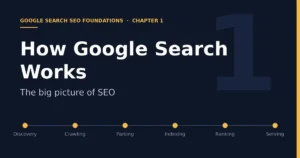
Google, Bing, Baidu, and Yandex are all search engines. They are not browsers: Chrome, Safari, and Edge are browsers, while Google Search is a search engine. An easy way to think about it is that a search engine is like a global information database that keeps expanding and updating. Every day the internet produces a huge amount of new web pages, products, articles, websites, videos, and discussions, and the search engine has to solve these problems: how do I find all of this information, how do I understand it once I find it, how do I organize it once I understand it, and when a user searches, which result should I put first? Google Search can therefore be understood as a series of consecutive processes, as follows.
Discovery → Crawling → Parsing/Understanding → Indexing → Ranking → Serving
What SEO does is work around this chain so that your website can enter the system as smoothly as possible.
2. How Does Google Find Your Website?
Google cannot browse the internet manually. It relies on automated programs, commonly called crawlers or spiders. One of Google’s main crawlers is Googlebot, which continually discovers new URLs on the internet, as well as existing URLs that have changed. When Google discovers a website, it does not mean it has truly understood that website; this is only the first step. Think of it this way: Google has found your company’s building on the internet, but many things remain undone after finding it. It still needs to know whether it can enter the building, whether it can tour it normally once inside, what is inside, what rooms there are, which rooms are the most important, what industry the building belongs to, how it relates to other buildings, and, if someone asks a question about this industry, which room in the building is best suited to answer. This is where SEO really begins.
3. After Google Finds You, It Still Needs “Access Permission”
When a search engine discovers your URL, it only means it knows the URL exists; it does not mean it can necessarily crawl that page normally. This is a very important concept in SEO: Crawlability. In the simplest terms, it is whether you have allowed the search engine to enter your room. Many technical factors are involved here, including robots.txt, HTTP status codes, login requirements, firewalls, CDN or WAF, IP blocking, noindex, JavaScript rendering, server stability, and whether the page returns normally. A very typical example is the robots.txt file, which tells search engines which paths may be crawled and which should not be. But note that robots.txt is not a switch for “forbidding Google from indexing”. It mainly addresses whether Google can crawl a URL, whereas noindex addresses a different question: even if the page can be accessed, do I want it to enter the search index? These two concepts must not be mixed up.
4. Being Able to Come In Does Not Mean the Crawler Can Understand You
Suppose Googlebot has arrived at your page. The next, very important question it faces is: what exactly is this page? This is where the Parsing / Rendering / Understanding stage begins. When humans see a web page, we understand it visually. For example, when we open a product page, we see a product image, we see “Roborock S8 Pro Ultra Side Brush,” we see “$15,” and below that we see “Compatible with Roborock S8 Pro Ultra.” A person can easily tell that this is a replacement side brush for the Roborock S8 Pro Ultra robot vacuum. But a search engine has no human visual intuition. It has to understand the page through the HTML, text, titles, links, images, image alt text, structured data, metadata, page structure, internal links, external references, and content rendered by JavaScript. Therefore, what a person sees is a visual page, while what a search engine faces is an information structure that can be parsed by a machine. This is why SEO has never been only “writing for people”: you must consider both how users understand the page and how machines understand it.
5. Why Is the Beginning of a Page So Important?
This brings us to a very important SEO mindset: lower the cost for search engines to understand the topic of a page. Imagine a page as an essay. If the first paragraph of an essay uses a lot of build-up without telling you “what this essay is actually about,” the reader has to keep reading to gradually understand it. But if the first paragraph tells you directly what the essay discusses, what problem it solves, who it is for, and what will follow, the whole process of understanding becomes very smooth. Web pages are the same, so the structure of a page should be as straightforward as possible. For example, on a product page, the title reads “Roborock S8 Pro Ultra Side Brush Replacement Set,” the H1 reads “Roborock S8 Pro Ultra Side Brush Replacement Set,” and the introduction clearly explains what this is, which models it fits, what problem it solves, what type of replacement part it is, and what other information can be found further down the page. Only after that come the product details, compatibility, specifications, installation and repair, and then the FAQ and related products. The point of doing this is not to mechanically “stuff keywords,” but to make the following logical chain clear.
Page topic → Subtopic → Product attributes → Use cases → User questions
6. From the “Whole” to the “Parts,” and from the “Parts” Back to the “Whole”
This is a very important way of thinking in SEO. An excellent website should not just have a large number of isolated pages. It should form a structure like the one below, and then reconnect these pieces of content through internal links.
Industry → Category → Product → Attribute → Question → Scenario
For example,
Consumer electronics → Smart home devices → Robot vacuums → Roborock robot vacuums → Roborock S8 Pro Ultra → S8 Pro Ultra side brush → S8 Pro Ultra side brush replacement → S8 Pro Ultra repair guide
In this way, what Google sees is no longer just “you have a page selling accessories,” but it gradually understands that the site has long been building a large body of related content around a certain brand, a certain product category, and a certain type of repair need. This is the mindset of Topical Structure / Topical Authority.
7. Once Google Understands Your Page, What Comes Next?
At this point, we have addressed three questions: can Google find you, can Google access you, and can Google understand you. But understanding you does not necessarily mean showing you. Google still needs to put your page into its search system, that is, Indexing. Simply put, Google organizes and analyzes the information on the page and decides whether to include it in the search index. But there is a misconception that SEO beginners very easily fall into: “As long as my page is indexed by Google, I have succeeded.” That is not the case. Being indexed only means entering the competition; it does not mean winning first place, or even reaching the first page.
8. Why Does “Being Indexed” Not Equal “Ranking”?
Suppose Google has 10,000 pages about “Roborock S8 Pro Ultra side brush replacement.” Google cannot put all 10,000 pages on the first page of search results. It must answer: when a user searches this query, which result is most likely to meet their needs? This brings us to the core layer of SEO: Ranking. A search engine has to sort candidate results based on a large number of signals. Never understand Google ranking as “the more times a keyword appears, the higher the ranking.” Modern search is far more complicated than that. Google comprehensively evaluates the following dimensions.
1. Relevance. Whether the page actually answers the user’s question. If a user searches “Roborock S8 Pro Ultra side brush replacement” and a page mainly discusses “Roborock S8 Pro Ultra battery life,” although it also concerns the S8 Pro Ultra, it does not fully match the current search intent. So relevance is not “whether the keyword is present,” but “whether the page truly satisfies this search need.”
2. Content Quality. Whether the page provides genuinely valuable information. For example, a product page that says only “High quality parts. Buy now.” offers clearly less informational value to users than a complete page that lists compatible models, part specifications, material descriptions, whether installation tools are included, warranty information, test results, and the return policy.
3. Experience. This is the first E in E-E-A-T. For example, if you have really repaired a large number of robot vacuums, then real repair photos, test videos, installation tutorials, failure cases, repair experience, and genuine product testing can all help build evidence of real experience.
4. Expertise. Whether you truly understand this field. For example, a website that has long built extensive professional content around robot vacuum repair, robot vacuum main brushes, robot vacuum batteries, robot vacuum filters, and robot vacuum repair guides is clearly different in professional topical structure from a website that writes about robot vacuums today, coffee machines tomorrow, and pet food the day after.
5. Authoritativeness. Whether others recognize your standing on this topic. This involves external signals such as industry media, professional websites, industry organizations, experts, partners, citations from other websites, brand mentions, and external links.
6. Trustworthiness. This is a very important part of E-E-A-T. For example, company information, contact details, return policy, warranty information, shipping information, secure payment, author information, product authenticity, customer reviews, website security, and whether the content is accurate all help users and search systems judge whether this website is worth trusting. Therefore, E-E-A-T should be understood as an important framework for evaluating content and source quality, not as a simple “Google score.”
9. Why Does Google Have to Be So Complicated?
Because Google ultimately serves not SEO practitioners but users. When a user enters “Roborock S8 Pro Ultra side brush replacement,” the real problem Google needs to solve is “what result should I give this user?” Therefore, Google’s ultimate goal is not to “make SEO practitioners happy,” but to satisfy searchers’ information needs as quickly and accurately as possible. So the essence of SEO should also return to this: we are not deceiving Google into ranking us; we are helping search engines understand our value more accurately and making our pages an effective answer to users’ questions.
10. What Problem Does Ranking Actually Solve?
Now we can string the entire Google Search process together. Step one is discovery: “I have discovered this URL.” Step two is crawling: “Can I access this URL?” Step three is parsing and understanding: “What is this page, exactly?” Step four is indexing: “Should I include this page’s information in my search index?” Step five is ranking: “Among all relevant results, where should this page appear?” Step six is serving: “Which searchers do I show it to?” This is the most basic operating logic of Google Search.
11. Once You Understand This Chain, Many SEO Actions Are No Longer Islands
The most common problem in SEO is that you learn Titles today, backlinks tomorrow, blogging the day after, Schema a few days later, and then start studying keyword density, until all your knowledge is isolated. But once you understand how Google works at the bottom layer, you will find that every SEO action is actually serving this chain.
12. Why Do We Do Keyword Research?
Keywords are not simply to be “stuffed into web pages.” What keyword research really solves is that we need to know what users are searching for and how Google should understand our business. For example, for a home appliance website, you may initially have only one very large concept, household appliances. But that term is too big, so we keep breaking it down, as follows.
Household appliances → Smart home devices → Robot vacuums → GPS/laser-navigation robot vacuums → Roborock robot vacuums → Roborock S8 series → S8 Pro Ultra → S8 Pro Ultra side brush → S8 Pro Ultra side brush replacement
At this point keyword research is no longer just SEO work; it is actually re-sorting out your products, users, market, and business structure.
13. What Kind of Keyword Is Suitable as a Second-Level Keyword?
It is not the case that the higher a keyword’s search volume, the better it is as a second-level category. A second-level keyword should meet a very important condition: it can form an independent topic set on its own. Take “robot vacuum,” for example. Beneath it you can keep producing content such as Roborock robot vacuums, Ecovacs robot vacuums, Roomba robot vacuums, robot vacuum main brushes, robot vacuum batteries, robot vacuum repair, and robot vacuum accessories, so robot vacuums can form an independent category. Take “air fryer” as another example. It can be further split into Ninja air fryers, Philips air fryers, air fryer baskets, air fryer heating elements, and air fryer repair, which is also a complete topic set. So a good second-level keyword should essentially be able to answer: “Under this term, can I still naturally organize a batch of products, a batch of pages, and a batch of search needs?” If so, it has the potential to become a category-level topic.
14. Keyword Tiering Is Actually Redefining the Website
When we divide keywords into the following tiers, we actually accomplish three things at the same time.
Level 1: Industry → Level 2: Category → Level 3: Product → Level 4: Attributes/Questions/Search intent
First, you re-sort the website structure, and you will know what the homepage should talk about, what category pages should talk about, what product pages should talk about, and what the blog should talk about. Second, you re-sort the product structure, and you will discover which products should belong to one category, which products can form a new product line, and which products lack content support. Third, you re-understand your market, and you begin to know what users are actually searching for, what users buy, why they buy, what problems they encounter, and which needs are not yet met. So, an excellent SEO practitioner is actually not just a search engine optimizer; he or she also participates in product planning, website architecture, content planning, brand positioning, user research, and market analysis.
15. Why Can an E-commerce Website Not Rely on a Blog Alone?
A blog is only one page type of a website. For a website that sells online, the entry points through which users enter can include at least the homepage, category or collection pages, product pages, blogs or guides, comparison pages, repair guides, FAQs, and other landing pages, and these pages take on completely different tasks. The homepage answers “who are you,” category pages answer “what do you sell,” product pages answer “what exactly do you sell,” blogs answer “what do you understand,” guides answer “what problems can you solve,” and comparison pages answer “what are the differences between the options.” So, a truly mature website should not put all its SEO on the blog.
16. The Core of SEO Is Not “Writing More Articles” but Building a Complete Information System
For example,
Roborock
↓
Roborock robot vacuums, Roborock wet-dry vacuums, Roborock robotic mowers, Roborock accessories
↓
S7 series, S8 series, Q series, G series
↓
S8 Pro Ultra, S7 MaxV Ultra, Q Revo, G20
↓
Main brush, side brush, filter, battery, dustbin
↓
Replacement, repair, installation, troubleshooting
In this way, the whole website begins to form a knowledge network that runs from industry to product, from product to problem, and from problem back to industry, and this is more valuable than simply writing one “robot vacuum xxx” article every day.
17. Why Do Internal Links?
Because Google does not get to know you only through individual pages; it can also understand the whole website through the relationships between pages. For example,
Robot vacuums → Roborock robot vacuums → S8 series → S8 Pro Ultra → S8 Pro Ultra side brush replacement → S8 Pro Ultra repair guide → Robot vacuum repair accessories
At this point a network forms inside the website, and Google no longer sees just a few isolated pages; it sees an information system built around robot vacuum repair.
18. So Why Do Backlinks?
If on-site SEO tells Google “who I am,” then off-site SEO addresses “what others on the internet think of me,” which is why backlinks matter so much. Suppose a website says “I am a robot vacuum repair expert.” That is a self-description. But if industry media cite you, professional websites link to you, partners introduce you, industry articles cite your research, and related websites mention your brand, then the search engine gains another kind of information: other nodes on the internet are associating you with this topic. Therefore, backlinks should not be simply understood as “adding weight to my website.” A deeper understanding is that they build real relationships between the website and other nodes on the internet.
19. Why Should Backlinks Come from Peers, Upstream and Downstream Partners, and Industry-Related Websites?
Because links are not entirely without context. Suppose a completely unrelated website suddenly gives you a link, versus an industry website that has long discussed robot vacuums, smart homes, and appliance repair giving you a link. These two links obviously differ in their semantic relationship. So what truly deserves attention in high-quality link building is relevance, authenticity, source quality, and the context in which the link arises, rather than simply pursuing “I’m going to post 100 backlinks today.” The SEO mindset should gradually upgrade from quantity to relationships.
20. What Is the Relationship Between SEO and SEM?
SEO and SEM are often confused. Simply put, SEO mainly addresses organic search traffic (Organic Search), while search advertising or PPC addresses paid search traffic (Paid Search), so Google Ads is not part of SEO. Likewise, Facebook Ads belong to paid social (Paid Social), and YouTube influencer marketing belongs to influencer or creator marketing (Influencer / Creator Marketing). They all belong to the larger digital marketing or traffic acquisition system. However, they are not independent of one another. For example:
YouTube influencer → User learns about the brand → Searches the brand name on Google → Enters the website → Searches for the product again → Organic Search → Final purchase
So SEO practitioners should not understand only SEO traffic; they should understand the entire user acquisition path.
21. What Does a Truly Excellent SEO Practitioner Actually Do?
If SEO is understood merely as finding keywords, writing articles, and building backlinks, then an SEO practitioner’s capabilities are actually very limited. A truly mature SEO practitioner needs to understand at least seven aspects. First is the search engine, that is, how search engines discover, crawl, understand, index, and rank. Second is the user, that is, what users search for, why they search, and what the real need behind the search is. Third is the website, that is, site structure, page types, internal links, and technical architecture. Fourth is content, that is, how to organize knowledge, products, and user needs into content that search engines can understand and users are willing to consume. Fifth is the product, that is, what products are worth selling, why users need them, and how products should be categorized. Sixth is the brand, that is, how others on the internet come to know you. Seventh is acquisition channels, that is, how traffic from SEO, Google Ads, social media, YouTube, influencers, email, and so on influence one another. So, a mature SEO practitioner is more like a designer of a search traffic system than a producer of articles.
22. Therefore, SEO Can Be Re-understood as Two Directions
For an independent website, we can roughly understand the work of SEO as two directions. On-site SEO addresses “after Google enters my website, how do I make it understand me more clearly,” including site architecture, keyword structure, on-page SEO, content, internal links, technical SEO, structured data, user experience, product pages, and category pages, and it acts more directly on the search performance of the pages themselves. Off-site SEO addresses “after Google leaves my website, how does other information on the internet continue to prove who I am,” including backlinks, digital PR, industry mentions, brand mentions, partnerships, industry publications, and related external citations, and it addresses the website’s relationships and credibility within the entire internet environment.
23. So What Is the Real Goal of SEO?
It is not writing 100 articles, not building 1,000 backlinks, not getting keyword density to 2%, and not even getting a certain keyword to first place. These are only means or partial results. What SEO really needs to solve is: let search engines understand you, let search engines trust you, and let search engines know when they should show you to users. Ultimately a complete chain forms, as follows.
User need → Search Query → Google understands the Query → Google finds candidate results from the index → Understands page relevance and quality → Ranking → Serving → User enters the website → User solves the problem/completes a purchase
This is the complete search traffic chain.
24. The Underlying Logic of SEO Can Finally Be Condensed into One Sentence
If I had to compress the entire SEO methodology into one sentence, I would define it as: SEO is continuously lowering the cost for search engines to understand you, trust you, and match you with user needs. And what an SEO practitioner really does is keep answering several questions around this sentence, as follows.
Can Google find me → Can Google access me → Can Google understand me → Can Google accurately determine which topic I belong to → Why should Google trust me → Does my page truly satisfy user needs → When a user searches this question, why should I appear in the results
Once you can string all these questions together, keywords, site structure, content, internal links, backlinks, product pages, blogs, technical SEO, and brand building are no longer isolated SEO tricks; they all become different actions within the same system. This is also why a truly excellent SEO practitioner should not define himself or herself as “someone who works on Google rankings.” A more accurate definition is: a builder of a traffic system that connects “user needs, website content, product value, and brand trust” through search engines.