Chapter 6: Ranking – How Google Ranks Pages: Ranking Systems Explained

- 6 min read
- 0
Only after a page enters the index does it truly begin to face searchers.
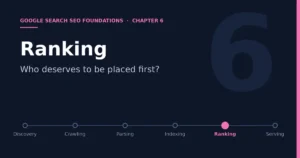
Discovery → Crawling → Parsing/Understanding → Indexing → Ranking → Serving
This chapter is the station on the whole chain that is most easily mystified and most easily misunderstood. To avoid drawing conclusions from imagination, this chapter is written mainly on the basis of Google’s official ranking systems guide, helpful content guidance, and page experience documentation. Anything the official documentation does not state explicitly is not written here as fact.
1. Ranking Is Not a Formula but a Set of Systems
The official “A guide to Google Search ranking systems” states it clearly: Google uses automated ranking systems that combine a large number of factors and signals to evaluate hundreds of billions of web pages and other content in the search index, and present the most relevant and useful results in a fraction of a second. The official documentation also stresses that ranking systems mainly work at the page level, while also using site-wide signals and classifiers to help understand pages. But some good site-wide signals do not mean all content on the site will rank well, and conversely, some poor site signals do not mean all content will rank poorly. In addition, the official documentation restates a premise: Google does not accept payment to improve rankings, and ranking is done programmatically. So there is no single ranking score that can be optimized on its own; ranking is the result of multiple systems working together on every query.
2. The Main Ranking Systems Listed Officially
The systems still in operation listed in the official guide can be divided into several categories by function. Those that understand queries and the meaning of content include BERT, RankBrain, neural matching, and passage ranking. They are respectively responsible for understanding the meaning and intent of word combinations, understanding relationships between words and concepts, matching queries to concepts in pages, and identifying how relevant a specific passage in a page is to a search. Those that judge relationships between content and pages include the link analysis systems and PageRank. The official documentation says PageRank was one of Google’s core ranking systems when it first launched, and although how it works has evolved a great deal, it is still part of the core ranking systems. Those that ensure result quality and diversity include the duplicate content elimination system, the original content system, the reliable information system, the reviews system, and the site diversity system. The site diversity system generally prevents more than two page listings from the same site from appearing among the top results. For specific needs there is the freshness system, used for queries that should show newer content, such as a newly released movie or a recent earthquake. Against abuse there is the spam detection system, which includes SpamBrain. There is also the exact match domain system, used to avoid giving too much weight to a domain merely because it exactly matches the query.
The official documentation also specifically lists retired systems, for historical reference only, including the helpful content system, Hummingbird, Panda, and Penguin. The helpful content system was introduced in 2022 and has been folded into the core ranking systems since March 2024. Panda was introduced in 2011 and became part of the core ranking systems in 2015. Penguin was introduced in 2012 and was integrated into the core ranking systems in 2016. This means that claims still circulating online about optimizing for names like Panda and Penguin need to be understood in their historical context; they no longer operate as independent systems.
3. The Place of Links and Backlinks in the Official Position
In Chapter 1 we understood backlinks as proof of you from other nodes on the internet. From the official position, this understanding has a basis. The official documentation says Google has multiple systems for understanding how pages link to one another, used to judge what pages are about and which pages may be most helpful for a query, and PageRank is only one of them. At the same time, the official documentation also has systems targeting link spam. Although Penguin has been merged into the core, the spam detection system still handles behavior that violates spam policies. So the key with backlinks is not quantity but whether those links are real, relevant, and naturally earned, which is consistent with the conclusion of Chapter 1.
4. E-E-A-T and Helpful Content: What the Official Documentation Actually Says
In “Creating helpful, reliable, people-first content,” the official documentation explains that Google’s automated systems first find relevant content and then prioritize the content that seems most helpful. To do this, they identify a set of factors to determine which content demonstrates experience, expertise, authoritativeness, and trustworthiness, that is, E-E-A-T. The official documentation immediately gives three important qualifications. First, among these aspects, trust is the most important, and the others are components that contribute to trust; content does not need to demonstrate all of them. Second, E-E-A-T itself is not a specific ranking factor, but it is useful to use multiple factors that can identify good E-E-A-T. Third, for topics that could significantly affect people’s health, financial stability, or safety, the systems give more weight to content that aligns with strong E-E-A-T. This is exactly the official basis for Chapter 1’s understanding of E-E-A-T as a framework for evaluating content and source quality rather than a Google score.
The official documentation also provides a set of self-assessment questions, for example whether the content provides original information, reporting, research, or analysis, whether it gives a substantial and complete description of the topic, and whether readers would feel they learned enough after reading. For an accessories site, the gap under this set of self-assessment questions between a repair guide with real disassembly photos, model correspondence tables, test records, and installation steps, and a page with a one-sentence product description is obvious.
5. Page Experience and Core Web Vitals
The official page experience documentation explains that there is no single page experience ranking signal. The core ranking systems consider multiple signals that align with overall page experience, and Core Web Vitals are used by the ranking systems. The official documentation recommends that site owners strive for good Core Web Vitals, but also cautions that getting good scores in Search Console or third-party tools does not guarantee ranking at the top of search results, that good page experience is more than Core Web Vitals, and that chasing a perfect score purely for SEO may not be the best use of time. Another official blog post adds that good page experience cannot replace great content. The specifics of page speed and Core Web Vitals were previewed at the end of Chapter 1 and will be covered separately in a later topic. For this chapter, just remember the official position: it is a plus, not something that overrides relevance and content value.
6. Core Updates: Why Rankings Fluctuate
The official documentation divides ranking changes into two categories: continuously running systems, and one-time updates such as core updates and spam updates. In its core updates documentation, the official documentation adds that Google continually makes improvements to its search algorithms, including smaller core updates, and site owners who improve their content do not have to wait for the next big core update to see rankings rise. Therefore, when you see ranking fluctuations, the more prudent approach is to first check the official ranking updates history, then go back and examine the affected pages using the helpful content self-assessment questions, rather than immediately changing titles or stuffing keywords.
7. A Checklist for the Roborock Accessories Site
First, for each key accessory page, confirm the search intent it corresponds to, whether a replacement tutorial, a compatibility query, or a purchase, and make sure the page content answers that intent completely. Second, fill out content with real repair experience, such as original photos, test results, common failures, and installation steps. Third, put company information, contact details, return and warranty terms, and shipping information in easy-to-find places, since these are components of trust. Fourth, avoid piling up similar pages for the sake of search, to prevent being dragged down by clustering and quality evaluation. Fifth, when observing ranking fluctuations, first look at the official updates history, then at your own page quality, and do not attribute all fluctuations to any one fixed factor.
8. Chapter Summary
Ranking solves the problem of who deserves to be placed first among all candidate results. It is decided jointly by multiple systems, not by a formula that can be optimized at a single point. Once the results are sorted, the final step is how to present them to the searcher.
Discovery → Crawling → Parsing/Understanding → Indexing → Ranking → Serving
References
· A Guide to Google Search Ranking Systems, developers.google.com/search/docs/appearance/ranking-systems-guide
· Creating Helpful, Reliable, People-First Content, developers.google.com/search/docs/fundamentals/creating-helpful-content
· Understanding Google Page Experience, developers.google.com/search/docs/appearance/page-experience
· The Role of Page Experience in Creating Helpful Content, developers.google.com/search/blog/2023/04/page-experience-in-search
· In-Depth Guide to How Google Search Works, developers.google.com/search/docs/fundamentals/how-search-works
· Google Search Documentation Updates, developers.google.com/search/updates